The consultation note: a wall between you and your patient
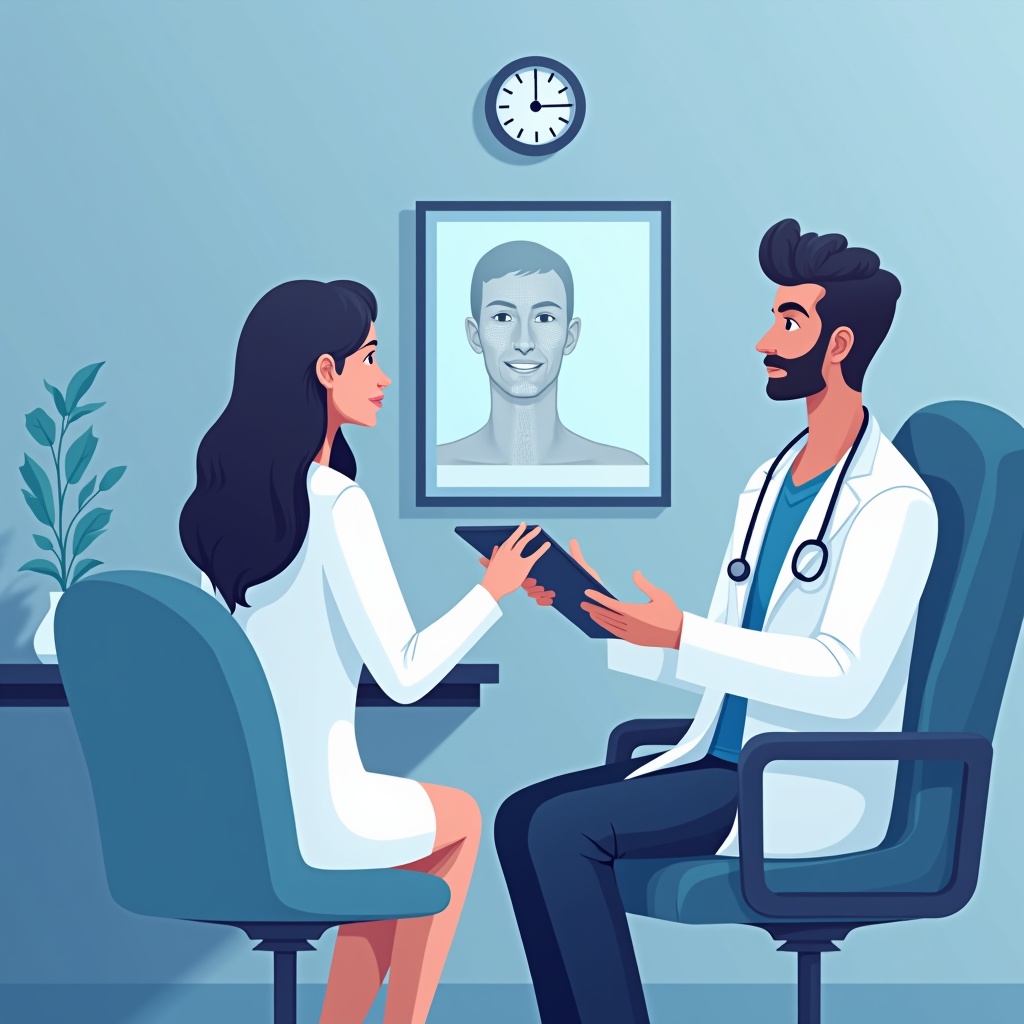
During an aesthetic consultation you are constantly split between listening and typing: history, expectations, products injected, zones treated, before/after photos, quote, consent. Every line you type in real time is a moment spent looking at your software instead of your patient. An AI medical scribe for aesthetic clinics flips that constraint on its head: the AI listens to the exchange, turns it into a structured summary, and files it in the patient record — without you typing anything during the consultation.
In plain terms, a medical scribe is the assistant who writes the note so the clinician doesn't have to; an AI scribe does the same job by transcribing and then summarizing the conversation into a usable clinical note. What sets it apart from a generic scribe is a detail that matters enormously in aesthetics: the note has to land in the right place — next to the photos, the quote and the consent — not in an isolated document you'll have to retype. That is exactly what Consult AI, the Nextmotion consultation module, does: the AI listens, summarizes, and drafts the quote; you validate.
What an AI scribe actually captures in an aesthetic consultation
A useful set of AI consultation notes in aesthetic medicine does more than transcribe word for word. It follows the real path of the visit and pulls out what matters for the record and for follow-up.
From listening to a structured summary
The AI listens to the whole exchange and produces an ordered synthesis: reason for the visit, relevant history, stated expectations, treatment plan discussed. You review, correct if needed, and save. The payoff isn't trivial: you offload the cognitive weight of writing and, above all, keep eye contact with the patient — which in aesthetics often decides whether a consultation converts or stalls.
Injectables: products, zones, traceability
For an injectable procedure the note must record the product, the zone, the quantity and the technique. That is both a clinical follow-up requirement and a medico-legal record: if a dispute arises, a precise chart protects you. An AI scribe structures this information and attaches it to the session, where a raw dictation would leave you a block of text to rework by hand.
The note wired to the record: photos, quote, consent
This is where a purpose-built module beats a standalone tool. The consultation summary sits alongside the standardized before/after photos, the quote generated from the exchange, and the signed digital consent. From that same consultation, the AI proposes the treatment line items and prices; you adjust in one click, the quote goes to the patient, ready to sign. We walk through that continuity in our guide to the digital consultation in aesthetic medicine.
Voice dictation vs. AI scribe: which should you choose?
Voice dictation turns your speech into text: you dictate, it writes. Useful, but you still have to actively compose the note, usually after the patient has left. An AI scribe listens to the two-way conversation and synthesizes it: you dictate nothing, and the AI separates what belongs in the treatment plan from ordinary discussion. In practice, dictation is a data-entry tool; an AI scribe is a writing tool. For an aesthetic consultation dense with products, zones and prices, the second approach saves the most time — provided the summary is wired into the rest of the record. Otherwise you've simply moved the problem.
Recording a consultation with AI: the rules to respect
This is the layer generic scribes ignore, and it is decisive. A consultation recording contains health data — a special category under the EU's GDPR. The European Data Protection Board sets strict conditions on transferring such data outside the European Economic Area. Three obligations follow.
Consent to recording and medical confidentiality
You cannot record a patient without their knowledge. Consent to the recording must be collected and logged, distinct from consent to the procedure. Medical confidentiality — in France, the secret médical, and the equivalent HIPAA duties in the US — does not vanish because an AI is involved: the summary remains a protected document, and it must never pass through a consumer service that would reuse its content. The right practice is to keep the recording and its transcription inside a controlled environment built into your practice software, rather than pasting the substance of a consultation into a public assistant. We break these principles down channel by channel in our article on GDPR and patient data in aesthetic clinics.
Where the data lives: health-data hosting
Once a recording or a note is stored on behalf of a healthcare professional, hosting is regulated. In France this means the health-data hosting framework known as HDS (Hébergement de Données de Santé), overseen by the national digital health agency, which publishes the list of certified hosts; the US equivalent is a HIPAA-covered environment under a business associate agreement. Nextmotion hosts reports, quotes and consents in Europe, on infrastructure designed to meet HDS requirements, with a partitioned space per clinic — the deeper topic we cover on our GDPR and compliance page.
Can the AI invent clinical details?
Yes, and it is not a point to wave away. Language models can "hallucinate" — produce a statement that sounds plausible but is false. In its guidance on large multi-modal models in health, the World Health Organization stresses this risk and the need for systematic human oversight. The EU AI Act likewise requires meaningful human oversight for high-risk AI systems, which can include AI used in healthcare. In the clinic this reduces to one rule: the AI proposes, you validate. The generated note is a draft you read before saving — never a note signed automatically. That copilot logic — the AI prepares, the clinician decides — runs through everything we build, as our Jarvis AI page explains.
Who it's for — and what it won't do
An AI medical scribe for aesthetic clinics is for the physician who loses time writing and wants to stay present with the patient, and for the multi-practitioner clinic that needs consistent records. It is especially relevant for consultations dense with procedures and quotes, where manual entry eats several minutes per patient.
What it won't do, and this needs saying plainly: the AI makes no diagnosis, decides no procedure, prescribes nothing. It replaces neither your clinical judgment nor your front desk — it lifts writing and re-keying off your shoulders. A patient who would rather not be recorded must be able to decline, and the consultation then proceeds as usual. Put back in context, the scribe is just one brick: our overview of AI in aesthetic medicine places consultation notes among the other tasks where AI saves time, and sending the summary to the patient runs through the patient portal.
Frequently asked questions
What is an AI medical scribe and how does it work?
An AI medical scribe is software that listens to a clinical consultation, transcribes it, and turns it into a structured note. Instead of typing during the visit, you speak with your patient normally; the AI produces a draft summary you review and validate before it is saved to the patient record. In a purpose-built aesthetic platform, that summary also connects to the quote, the consent and the before/after photos.
Are AI scribes accurate — do they hallucinate clinical details?
Language models can generate plausible but incorrect statements, so an AI scribe's output must always be reviewed by the clinician before it is saved. The World Health Organization explicitly warns about this risk and calls for human oversight. Treated as a draft rather than a finished note, an AI scribe is reliable; treated as an unchecked source of truth, it is not.
Is it legal to record patient consultations with an AI scribe?
Yes, provided the patient's consent to the recording is collected and logged, separately from consent to the procedure. A recording is health data — a special category under GDPR — so it needs a lawful basis, a clear purpose and appropriate hosting. A patient can decline the recording without preventing the consultation.
Do AI scribes work for injectables and aesthetic charting?
They can, when the scribe is built for the specialty. For injectables the note should capture product, zone, quantity and technique, and attach them to the session for clinical and medico-legal follow-up. A generic scribe leaves you a block of text; an aesthetic-focused scribe structures these details and wires them to the patient record, the quote and the photos.
See AI consultation notes on a real visit
The best way to judge an AI scribe is to watch it summarize a real consultation and generate the quote in seconds. Ask for a demo: we'll show you the full path — listening, summary, quote, consent, record — for your specialty. Book your Nextmotion demo and see what an AI medical scribe changes in your day.